Last night, I was talking to a dear friend, a lover of poetry of the most exquisite kind. He is pure charm. I could listen to him forever as he recites one charming line after another from the great Urdu poets of the past.
He knows about my retirement — or mini-retirement, as I prefer to call it. And he was urging me to return to the workforce.
His argument was simple: AI is coming. In five years, there may be very little left for people like us to do. We should seize this brief window, work as hard as we can, and convert whatever remains of our professional value into money — a safe harbor against the future.
This was not the first time he had made the argument. In fact, he had said almost exactly the same thing a year earlier, when I was first considering mini-retirement.
He had used the same five-year deadline then, too.
Twinkle, twinkle.
Still, when intelligent friends speak, they make you think. We had worked together. I knew his intellect was formidable and his instincts often sharper than mine.
So I began to wonder: Could he be right?
Was this truly the last great opportunity? Would I be wise to spend the next three or five years converting my professional accomplishments into financial security? Would I become unemployable at 50? Was I stepping away from work at precisely the moment when I should be clinging to it?
The fears were real. They carried particular force because they came from someone who had undergone much the same education and professional training as I had.
But after the conversation, as I lay in my bed thinking….. It came pouring down to me.
It was a classic fear — not rational foresight, but a classic fear. Fear of newness. Fear of the unknown, the unseen.
It was a collusion. The newness of artificial intelligence. The newness of growing older. The newness of becoming an older worker in the technology industry. The newness of watching the professional world we once understood begin to disappear.
It was a classic fear — not rational foresight, but a classic fear. Fear of newness. Fear of the unknown, the unseen.
And, most unsettling of all, the newness of seeing skills we spent decades acquiring suddenly reproduce-able by machines.
In graduate school we (me and him) worked on mathematical representations of complicated physical systems, operating in technical spaces that were understood by only a few specialists. Modeling physical systems required access to data, hardware, tools and expertise that was just not commonly available. You spend years, just having a working system to study, so that you can acquire data, and build models over it. It was a classic bench type setup. We would spend two years in the program, just learning to setup the ‘bench’ so that the right data can be acquired from the hardware.
Today, given the right prompt, an AI system can often produce a plausible working model in seconds.
During my PhD, I remember my adviser repeatedly asking a colleague to build a MATLAB simulation of a well-established physical phenomenon. Three years passed, and the model never quite materialized. He was unable to build it. Until I built it laboriously after many months of intense learning. (and that too only because I got an internship at Intel labs and got some ready access to mentorship)
Today, an AI tool might generate a version of it in three seconds.
That is an extraordinary form of newness: witnessing feats that would have seemed almost unbelievable only a few years ago.
There is also something psychologically profound about watching hard-acquired abilities become commonplace. These were not skills we picked up casually. We acquired them laboriously, patiently, inch by inch. They formed part of our professional identities. And now they appear to be slipping from our hands at breathtaking speed.
Something must be said about the shock of that.
But underneath the shock is still the same thing: newness.
And newness is frightening, especially before the brain has had time to build a mental model around it.
I read a very potent description of it, in Michelle Obama’s book The Light We Carry. As a child, she was expected to perform in a Christmas program, but a large turtle prop onstage terrified her. It looked strange and alien, and she did not want to go near it.
Her aunt Robbie, who had organized the performance, refused to remove the turtle. Michelle would have to decide whether she was willing to approach it and perform her part.
Slowly, she moved closer.
And as she did, the creature changed. It began to look less like a monster and more like a stuffed toy. Its eyes no longer seemed so enormous. It even became a little cute.
The turtle had not changed.
Her relationship to it had.
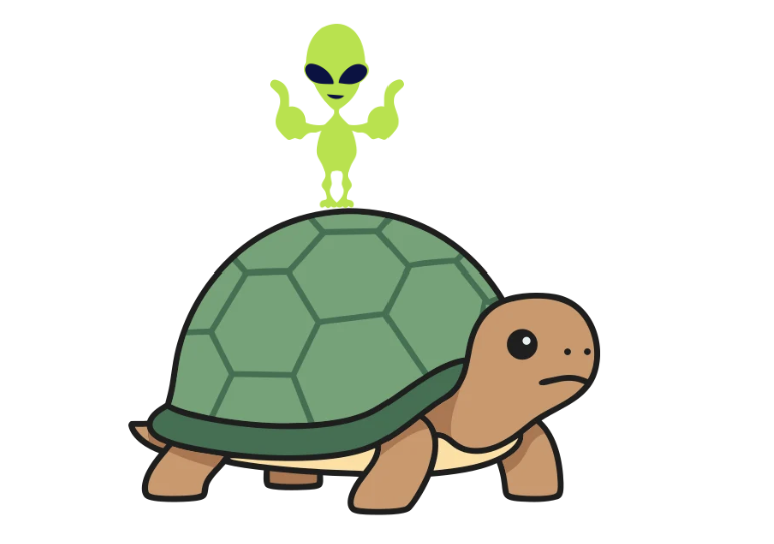
This is what happens with newness. The brain gradually builds a model of the unfamiliar world. What first appeared monstrous becomes legible. Its sharp edges soften. The bite begins to disappear.
AI is the frightening turtle on the stage.
It will continue to scare us for some time, especially those of us who have reached the peak of our expertise. We are watching knowledge accumulated through years of discipline being absorbed into machines at a speed that feels almost violent.
But fear does not always mean danger. Sometimes it simply means that we have not yet walked close enough to see clearly.
Newness is frightening. Change is frightening. That is why we remain captive to the status quo. We cling to established institutions, job descriptions, routines, professional identities, and carefully defended areas of expertise.
To release them can feel like a Herculean act.
And yet, somewhere beneath the fear, most of us know that another world exists.
Each of us carries an unlived life: a life we have imagined but never quite approached, a life that has remained suspended in the private theatre of the mind.
Caution alert : It is often likely that if you dont feel the pull of that unlived life, you have dimmed those longings with binge watching netflix shows or youtube shorts, night after night after night. Over the years, we have learned to dim those imaginings.
But stop numbing yourself for long enough, and the imagination returns.
Slowly, then insistently.
It reminds you of the work you wanted to create, the places you wanted to see, the relationships you wanted to deepen, and the person you once hoped to become.
That imagined life tends to fade as the years pass — the lack of action morphs into a perception of impossibility
The new world …. Our new world…. lies on the other side of fear.
Not metaphorically. Practically. Physically. In all its regalious glory.
As old shores recede, under the ferocious, towering wave of AI, we must be willing to set out …. to explore the unchartered. The untouched, unspoiled, untasted land where human spirit, dances in tango with our AI progeny.
To reach it, we must be willing to lose sight of the shore. We must accept that exploration offers no guarantees. Our plans may fail. Our ventures may collapse. Our ships may even sink. This is the worst. Right ? We go down trying.
But think about it. All it leads to, all it end in, is an inscription on tombstone that reads:
An explorer who got wrecked, searching for (his) new world.
Is that really so bad ?