About a year and a half ago, I was a midcareer professional. Totally afraid of making the leap. But one recurring thought was : I have my special music inside of me (still). I want to go out and play that tune.
This is for someone who is still thinking on those lines.
Professionals like us, continuously question if they can do a career pause, without breaking everything. Family, finances, future, etc.
Afraid of what exactly ?
But what are we afraid of exactly.
The thing with breaks that I found for myself was:
I was not actually afraid of what the break will cost. But afraid of what the aftermath of break will cost.
We know we have enough for taking a break. But are mortally afraid of what happensafter the break, and what trajectory life might take.
Its a classic human problem, of simulating too far into the future, and backpedaling to the present, to freeze your action in the moment.
Future simulation is important. Crucial even. But you have to remember the following : If you simulate too far into the future, you will hit uncertainty. Massive uncertainty. Of both the positive, and negative kind.
There is no way to simulate a future, which does not eventually run into a massive flux of uncertainty.
But the way our mind has been trained, over thousands of years, we never will take into account, positive uncertainty of the future. We discount positive uncertainties mercilessly. Not consciously. Not knowingly. But through the (evolutionary) probabilistic machinery of the mind.
What is multiple income regimes
The traditional retirement advice is very inflexible. It wants you to earn, and then stop earning and withdraw.
But that model does not include a career break. A time of exploration, adventure, realignment with your inner self. To find work that is genuinely fulfilling.
Multiple regimes of income are multiple time periods, where the income fluctuates between a wide margin of absolute zero, to a modest earnings, to high earnings based on work choices.
So to have a more realistic measure of what can we afford, we need to split into multiple regimes of income. Multiple time periods, where the income will fluctuate between 0 and modest. By combining these uneven zones, we get a more realistic idea of how far the money can go.
What regimes of income we break into
What are those income regimes that we consider?
Since we are going into a career break, we start with regime of zero income. A time when we are withdrawing, solely to fund our living expenses, while we do the job of architecting our re-invention.
Regime two would be to execute the career change, where we are able to land some kind of work that pays us while accounting for our inner satisfaction at this stage of life.
And third stage would be a tapering off, where work may not remain the primary focus of our life. This one can be delayed for quite a while, especially if the second stage works well.
The third and final stage of income can be delayed long enough into the future, especially if we are able to find meaningful work in the second stage.
Simulating with a 40 something old
You are smack dab in the peak years of your midlife. Energy and drive are still intact, while you try to figure out your move.
You have a decent sum of 500K spread across different kinds of asset classes, that you can tap into.
How long can you drive off the sum ?
Age does not exactly matter. The simulation will work even if you are a 35 year old. You just have to simulate for a while longer. For now lets say its 45.
If you were to just consume those 500K with a living expenses of 5K a month you will run through the money quickly. We assume a 7% return rate, which is just a conservative number you can use. If you don't do anything fancy with the markets, its achievable for most passive investing folks. Here is how the drawdown looks like.
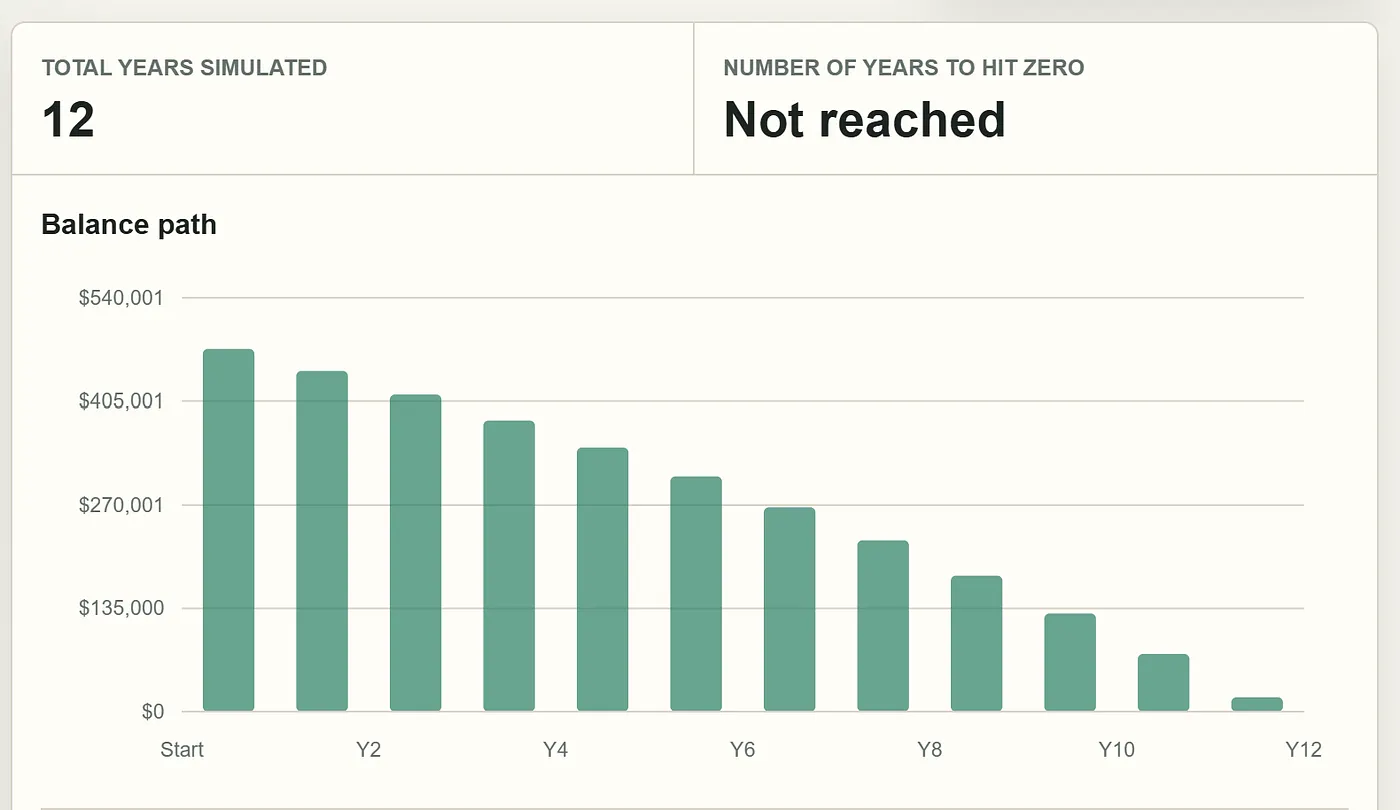
This is why the traditional retirement folks wont let you retire with this sum. You will hit zero in just 12 years.
But what if you only needed 5 years to re-invent ?
You are not going to a permanent retreat. You just need a pause, to reinvent and come back stronger. This can change the math remarkably.
Lets say after 5 years, I can make 3K a month from meaningful work that I have found. My withdrawal now comes down to just 2K a month. How does that fare ?
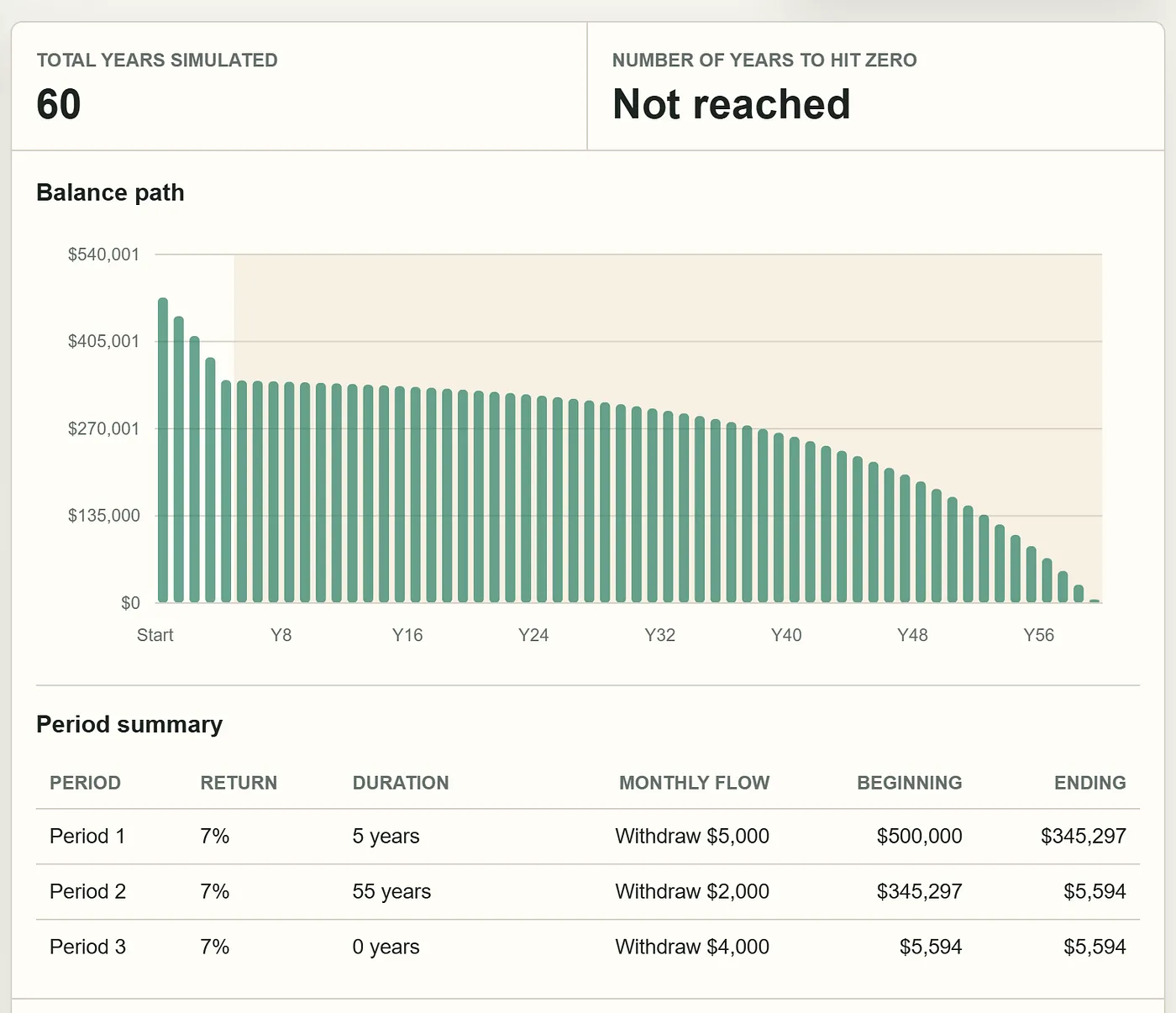
Here is where the traditional 4% withdrawal advice goes completely out the window.
With a realistic career pause change, the money extends from 12 to 60 years !
This is realism, for true career reinvention.
You could go for 60 years, without depleting your funds. This is practically forever ! A 45 year old will be 105. Maybe the technology will enable us to live beyond 100. Maybe not. Maybe us humans get tired of living that far, even if the technology allows. You could make these arguments about it. But the key point is, this is quite long. And quite safe. Within 60 years, there are a ton of inflexion points where you can pause and recalibrate.
What about the end ?
You might be thinking I cant live in that career until the very end.
Probably not. Though it could likely be until very close to the end. Imagine teaching high school, or doing community service that really brightens up the day.
But even still, we can add the final stretch, where the extra earnings drop to zero. Your expenses would have likely dropped too. So we will use a number 4000 for monthly expenses.
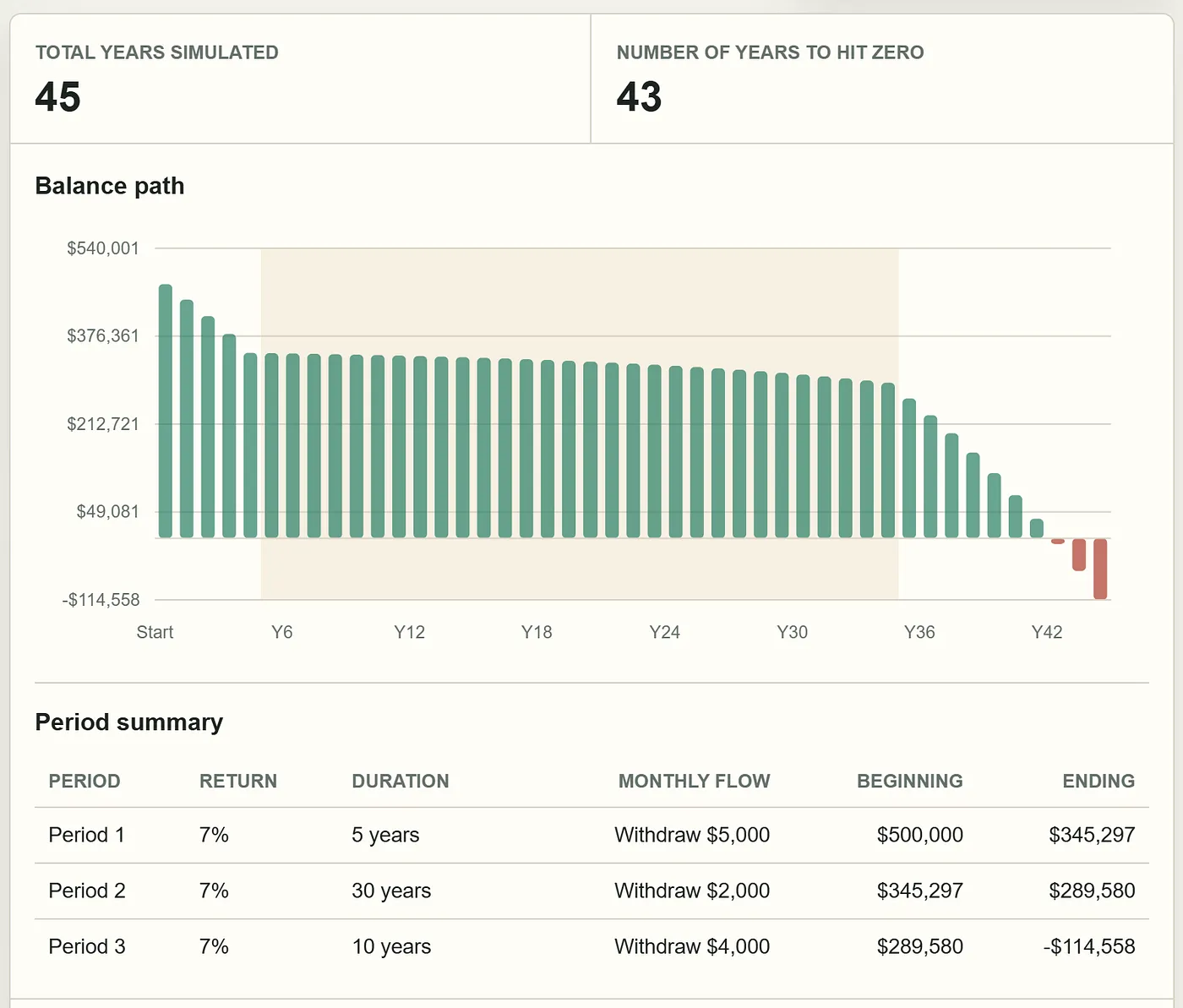
You took a break for 5, worked for 30 years in the new profession, and then took the last 10 years with no income at all.
In this case the money runs out. Towards the very end. We are left with a negative balance after 45 years.
That's the purpose of simulation like this. You can calibrate and adjust. There are many things that can be done here.
You can aim for slightly higher returns during the fat middle of the story.
You can aim for slightly more lucrative work during the middle
You can aim to setup some kind of passive business before running into the final leg.
Or any combination of the above.
You have a lot of flexibility to define that middle period, in a second career.
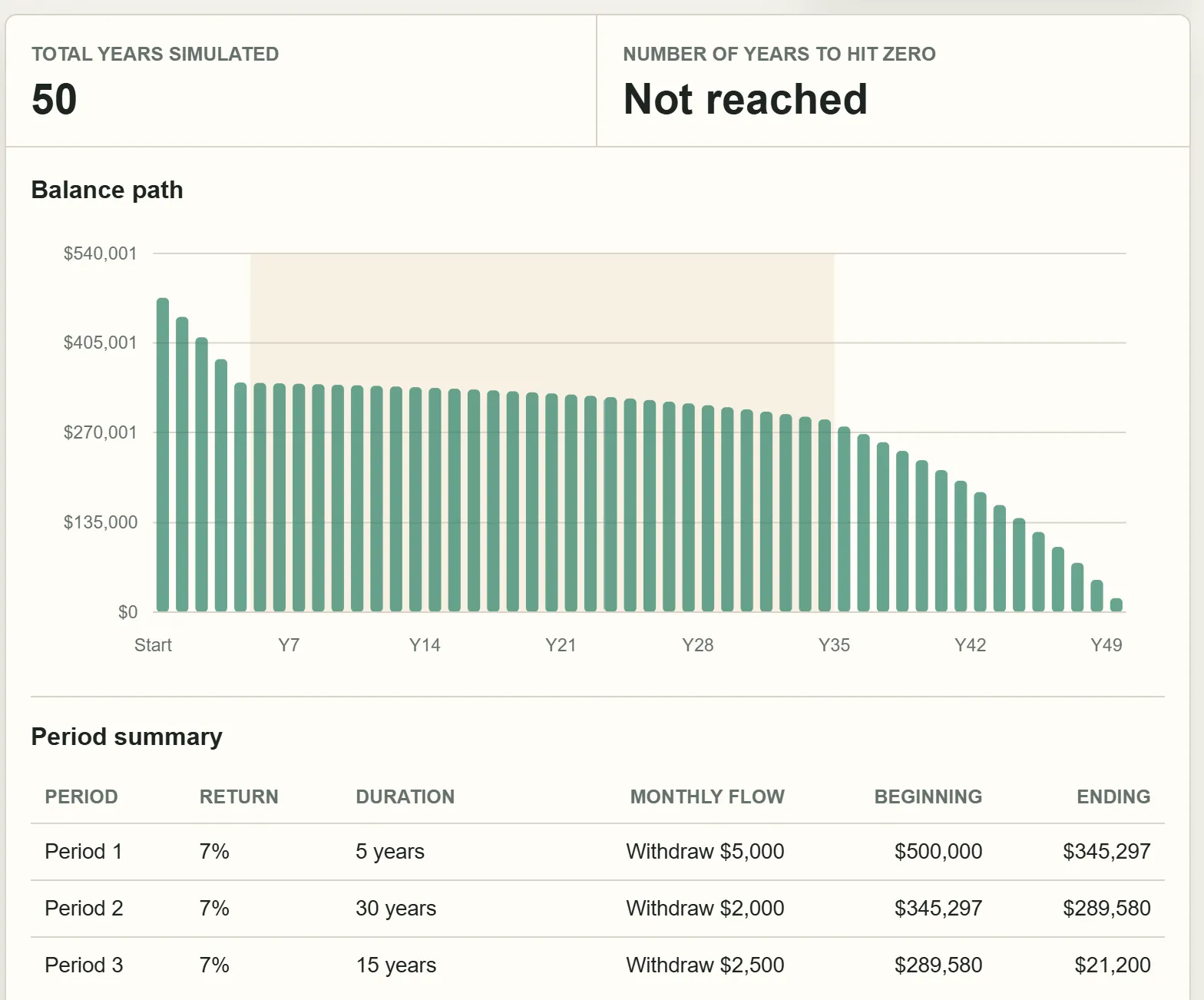
Lets go with the third. Having setup something that can generate a modest $1500 of extra income. Now that could also be just social security payments.
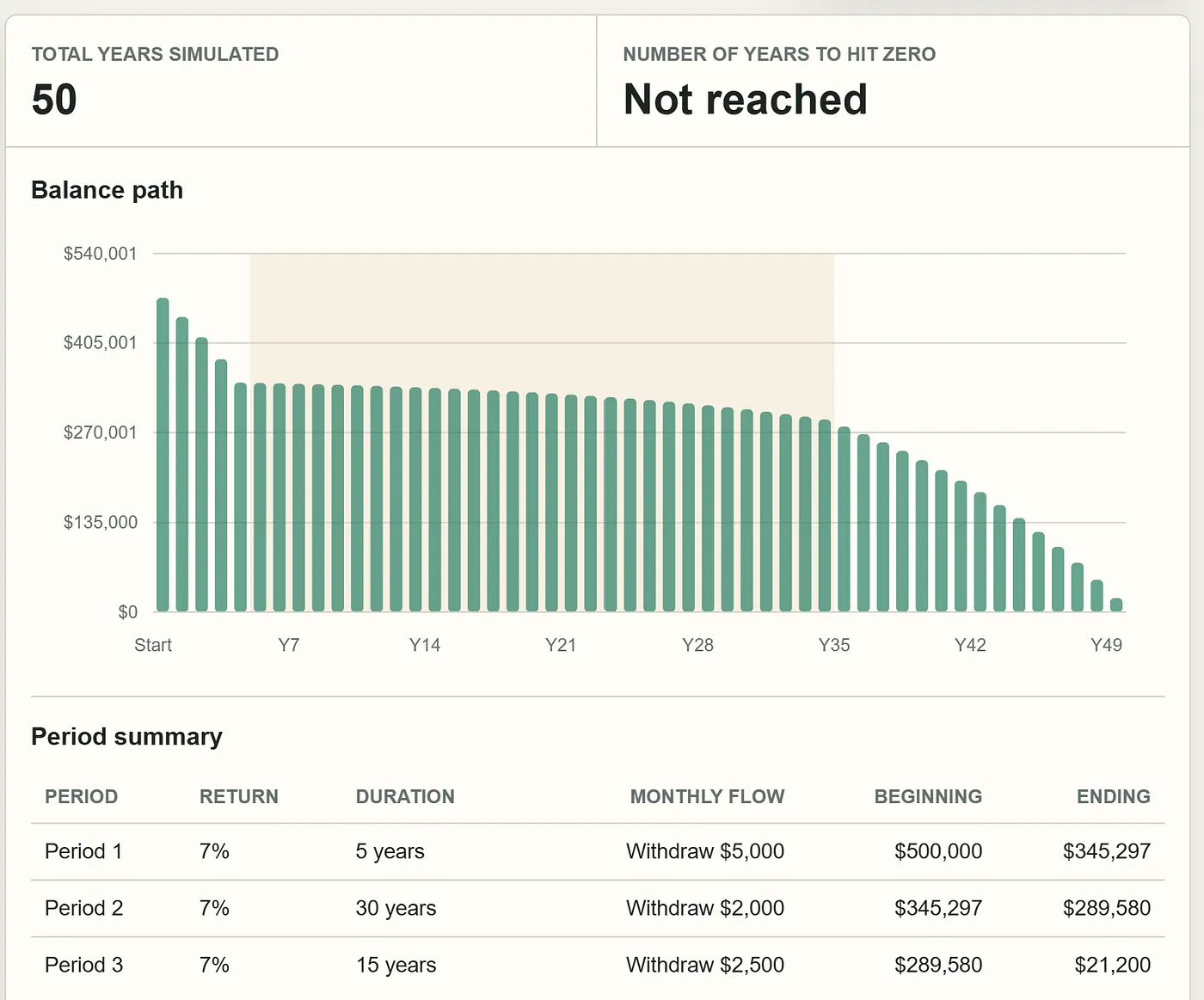
Now the simulations lasts 50 years and ends with a positive balance.
A similar tweak to the investment rate of return will also do the trick.
Your career break is the most flexible thing in the world
You can choose to define your break. What will you do in that break ? What will you do after that break ? How will you choose to end work ? Ofcourse life throws curve balls. Health deteriorates. Cognitive capacity slackens. But that still does not take away the fact that you have definitions of work to play with. The purpose of this article was to show that just by playing around with few of those definitions, you can extend what’s projected to be enough for 10+ years, to something that practically lasts a lifetime. Its all within the power of your imagination, to define what ‘work’ will consist of.