
Mini-retirement is doubly wrong. It may not be mini (extend to perpetual)…. and it may not be retirement in the traditional sense.
It is about stepping out of the machine long enough to realize that you are allowed to redesign your life.
You need that space …. to step out of your daily life…. to discover that a redesign is actual conceivable, even possible.
It is a pause with a purpose: a season to recover, reimagine, experiment, and eventually return to the world with more energy, more clarity, and perhaps an entirely different sense of what work is supposed to be.
The Big Question
But the obvious question remains: what kind of financial cushion makes that possible?
Let’s consider a simple scenario: someone in their 30s who began working in their early 20s and has now been at it for a decade or more. If they have been reasonably disciplined, avoided the worst lifestyle inflation, and benefited from a decent career, there is a meaningful chance they may have accumulated something close to $250,000.
Of course, this does not apply to everyone. Many people are underpaid, overburdened, or carrying obligations that make saving difficult. But there is another group of people for whom $250,000 is not unimaginable. Especially, if you are willing to consider all your sources. It may be sitting across investment accounts, retirement accounts, home equity, taxable holdings, or cash reserves.
And many of those people are afraid to touch it.
The number looks large when it is being saved. It looks fragile when it is being spent.
So the question becomes: how much life can $250,000 actually buy?
Cash Only Scenario : The baseline
Let’s begin with the simplest case. Suppose the money is held entirely in cash and used to fund a modest lifestyle of 4000 dollars a month. This will buy you a modest lifestyle in most any American city, outside of the two coasts. In this scenario, we are not accounting for inflation. The fund simply declines as living expenses are withdrawn.
The result is straightforward: the money lasts for roughly five years.
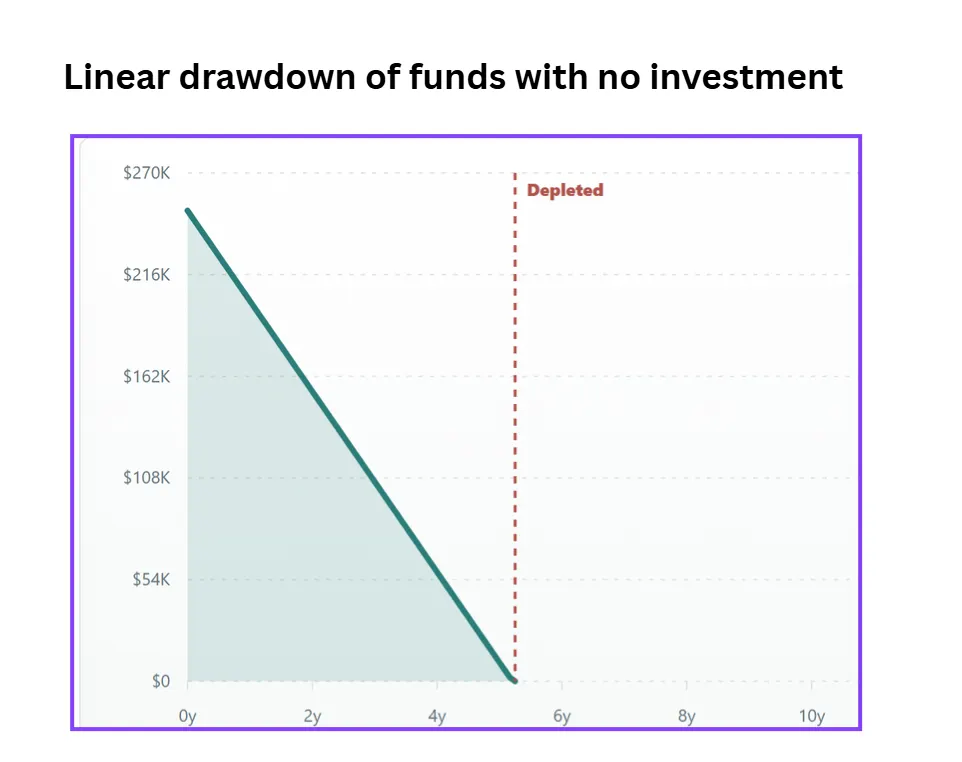
The decline is linear. There is no compounding, no recovery, no engine underneath the money. You are simply drawing down the pile until it reaches zero.
That is the version of mini-retirement most people fear. And this is the version that is the easiest to imagine, when it comes to drawing down on your savings.
You imagine a cliff. And a straight slide down into ever accelerating abyss.
You imagine walking away from work, watching your savings shrink, and eventually being forced back into the market in a weaker position than before.
But cash spending is only the base version of the story.
And a poorly designed one.
The First Lever : Investment
Now imagine that the same $250,000 is invested in a broad market fund. By “market fund,” I mean something that approximates the long-term historical return of the S&P 500. Over the last century, that return has been roughly in the high-single to low-double digits, though it includes inflation, volatility, crashes, lost decades, and long recoveries. The real return is lower, and the ride is never smooth.
Still, when we add investment growth to the simulation, the picture changes.
Instead of lasting five years, the money now lasts closer to seven years. Here is how the meltdown looks like.
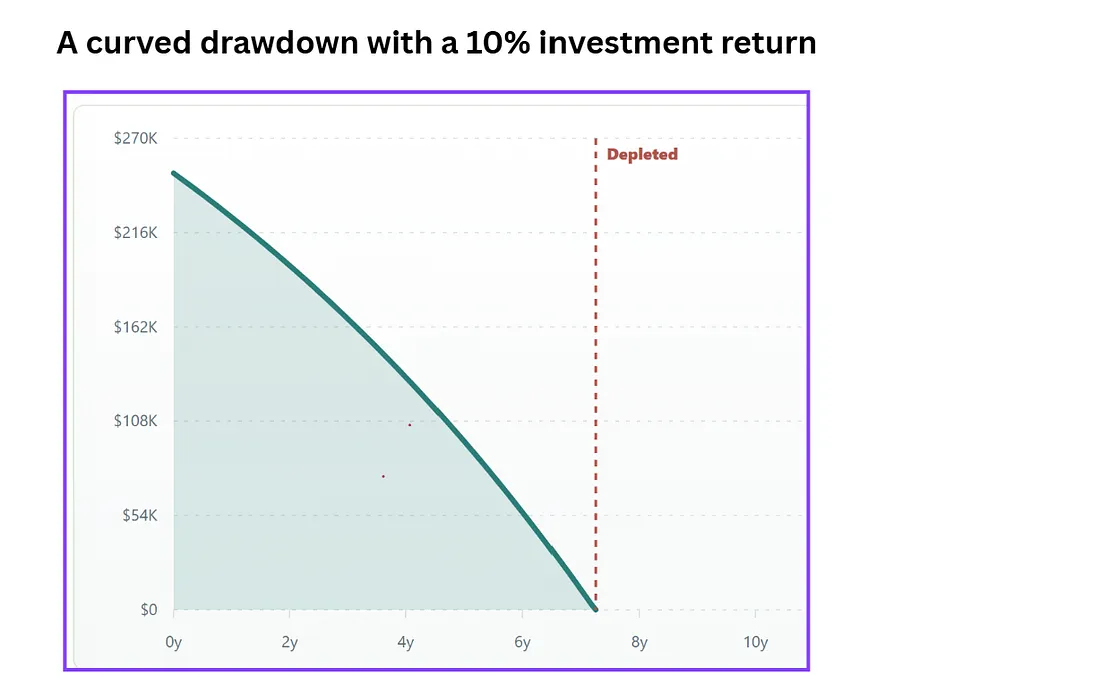
That is not enough to declare victory. Seven years is not permanent freedom. It is not financial independence. It is not a guarantee.
But it is something more interesting than a countdown.
It is a runway to do something. And that changes the psychology meaningfully.
A person with seven years of breathing room is not in the same position as someone with seven months of severance. They do not have to immediately monetize every idea. They do not have to panic-sell their skills to the first employer who will take them. They can recover first. Then they can explore.
They can ask better questions.
What kind of work gives me energy?
What do I know that others would pay to learn?
What expertise have I accumulated that could be packaged into consulting, coaching, writing, courses, advisory work, or a small service business?
This is where the second lever appears.
The first lever is investment return.
The second is supplemental income.
The Second Lever : Supplemental income
The supplemental income does not have to be dramatic to matter.
Suppose that in the third year of mini-retirement, a small income stream begins to materialize. Perhaps it comes from consulting. Perhaps from a course. Perhaps from a small business experiment, freelance work, writing, teaching, or a passion project that slowly becomes useful to other people.
Let’s say it produces just $1000 a month.
That may not sound transformative. It does not replace a professional salary. It does not make someone “financially free.” It is not enough to brag about online.
But in the simulation, that small income stream changes the runway dramatically.
The money now lasts almost ten years. Here is the drawdown. Notice the little notch that forms (shown by the arrow) at the year 3 mark.
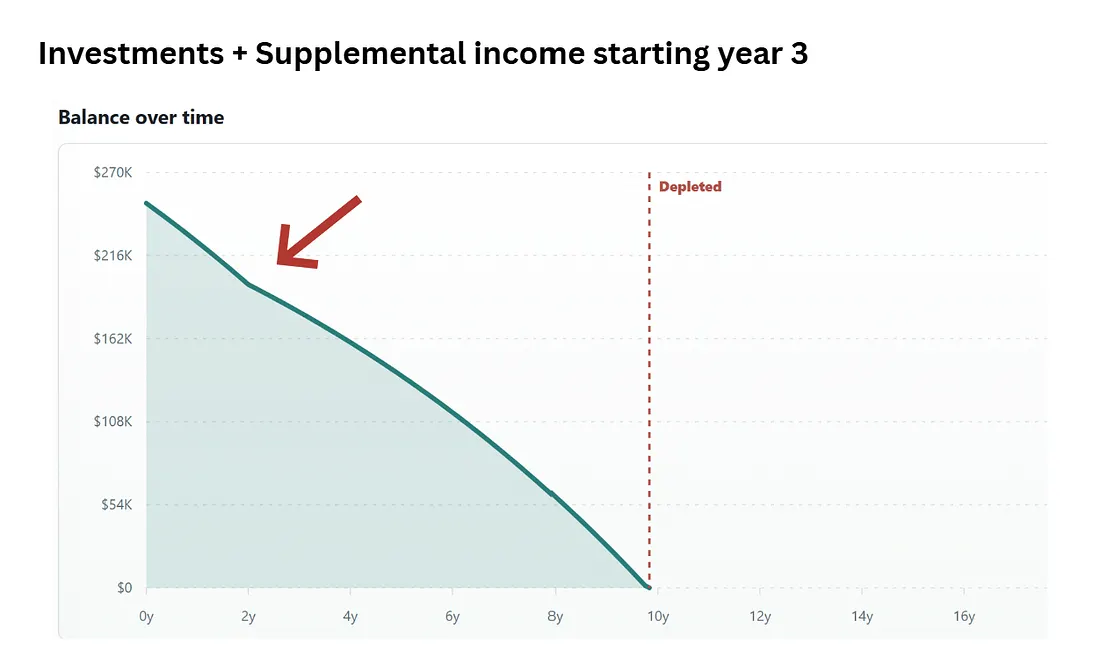
That is the hidden power of partial income. You do not need to replace your entire salary to change your life. You only need to slow the rate at which your savings are being depleted.
A modest income stream acts like a brake on the drawdown.
It buys time.
Now take the idea further. Suppose that by the third year, the person is able to generate $2,000 a month. That replaces half of a $4,000 monthly spending target.
The result is striking: the $250,000 runway stretches to roughly eighteen years.
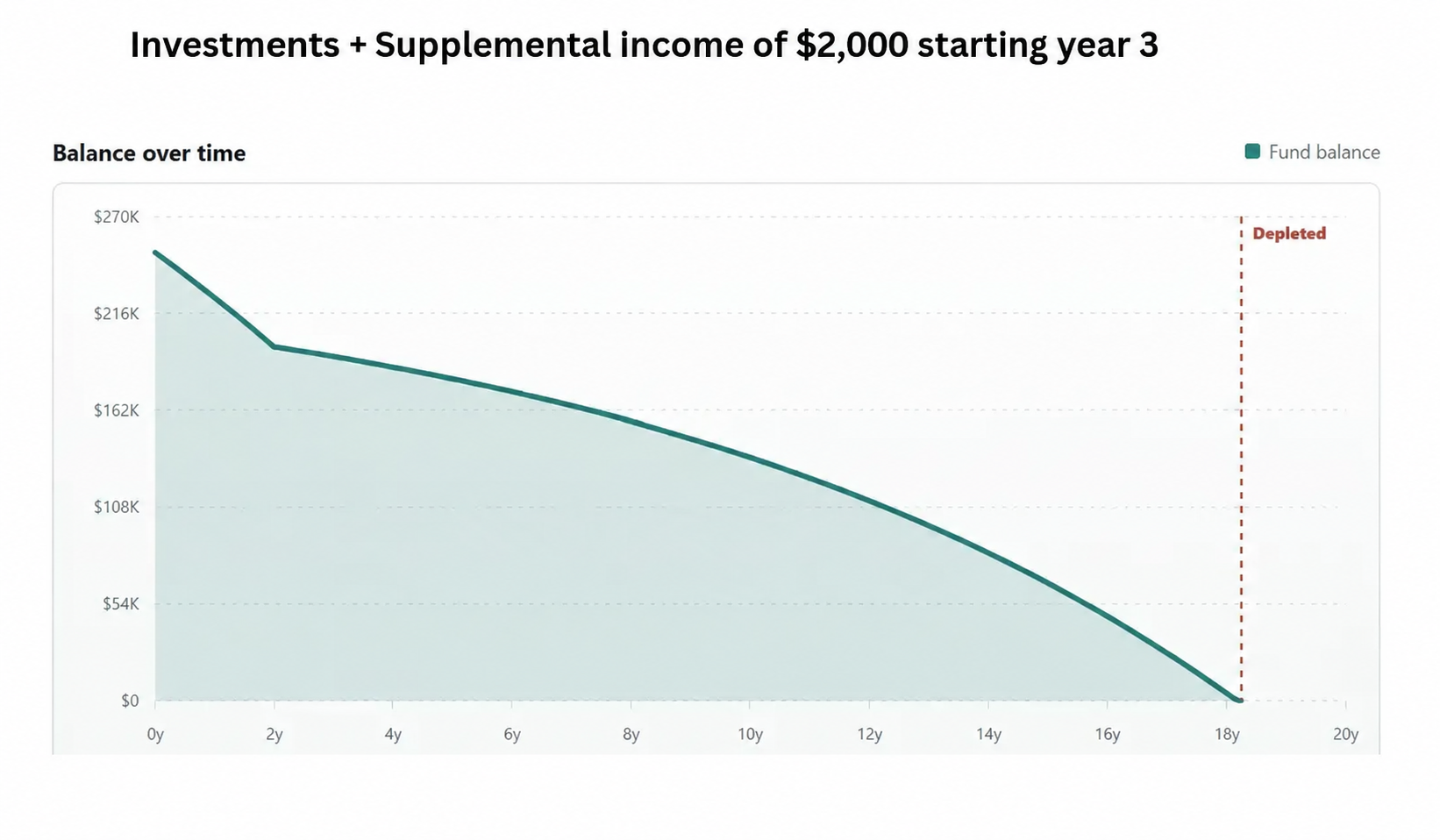
Eighteen years.
The contrast is almost absurd.
In the cash-only version, the money lasts about five years.
With market returns and meaningful supplemental income, it lasts closer to eighteen.
The difference comes from pressing two levers at the same time: investing wisely and earning even a partial income from work that is more self-directed.
Reframing Miniretirement
At that point, it is no longer useful to think of the mini-retirement as simply “time off.”
Eighteen years is too long to be a gap. It is too long to be an escape hatch. It is long enough to become a second life.
Over that span, the world will change. Industries will change. Technology will change. Entire categories of work may appear that do not exist today. Half-jokingly, perhaps some form of universal basic income will have entered the mainstream by then.
But the more important point is personal.
Over eighteen years, a curious and capable person will have crossed many milestones. They will have learned new skills, tested ideas, built relationships, created assets, developed judgment, and discovered where their particular strengths meet market demand.
They will likely have become more economically valuable, not less.
That is the part of mini-retirement that the anxious mind often misses. It imagines the money going down, but it does not imagine the person becoming more capable.
It sees the shrinking account balance, but not the expanding human capital.
And that may be the real argument for a well-designed mini-retirement.
The goal is to use $250,000 as a bridge between one version of your working life and another.
A bridge from being-steered to agency.
From a narrow job description to a broader identity.
From doing what pays today to discovering what could sustain you tomorrow.
Practical Lesson
The practical lesson is simple: $250,000 by itself may not be enough to retire forever. But it may be enough to buy a serious period of reinvention, especially if it is combined with sensible investing and a realistic plan for supplemental income.
And the income does not have to appear immediately.
In these simulations, it begins in year three. That means the first two years can be used for recovery, learning, experimentation, skill-building, and finding the overlap between what you are good at, what you care about, and what other people value.
That is a long time.
Long enough to write, build, consult, teach, design, advise, or start again.
Long enough to ask the question most working adults rarely get the space to ask:
What would I love to do if I did not have to do it for money?
There is a good chance that somewhere inside the answer is the seed of supplemental income.
Epilogue
Every hobby of yours does not have to becomes a business.
But when a skilled person finally has time, attention, and freedom, they often discover ways of creating value that were invisible to them inside the daily grind.
That is the promise of the $250,000 mini-retirement.
Not permanent escape.
A funded reinvention.